
12 April 2026 · 6 min
The Craft
Nine months on a single Lemga
A tissue panel, twenty-six metres of dabka thread, and the hours of a single karigar. How the heaviest part of a bridal trousseau is made.
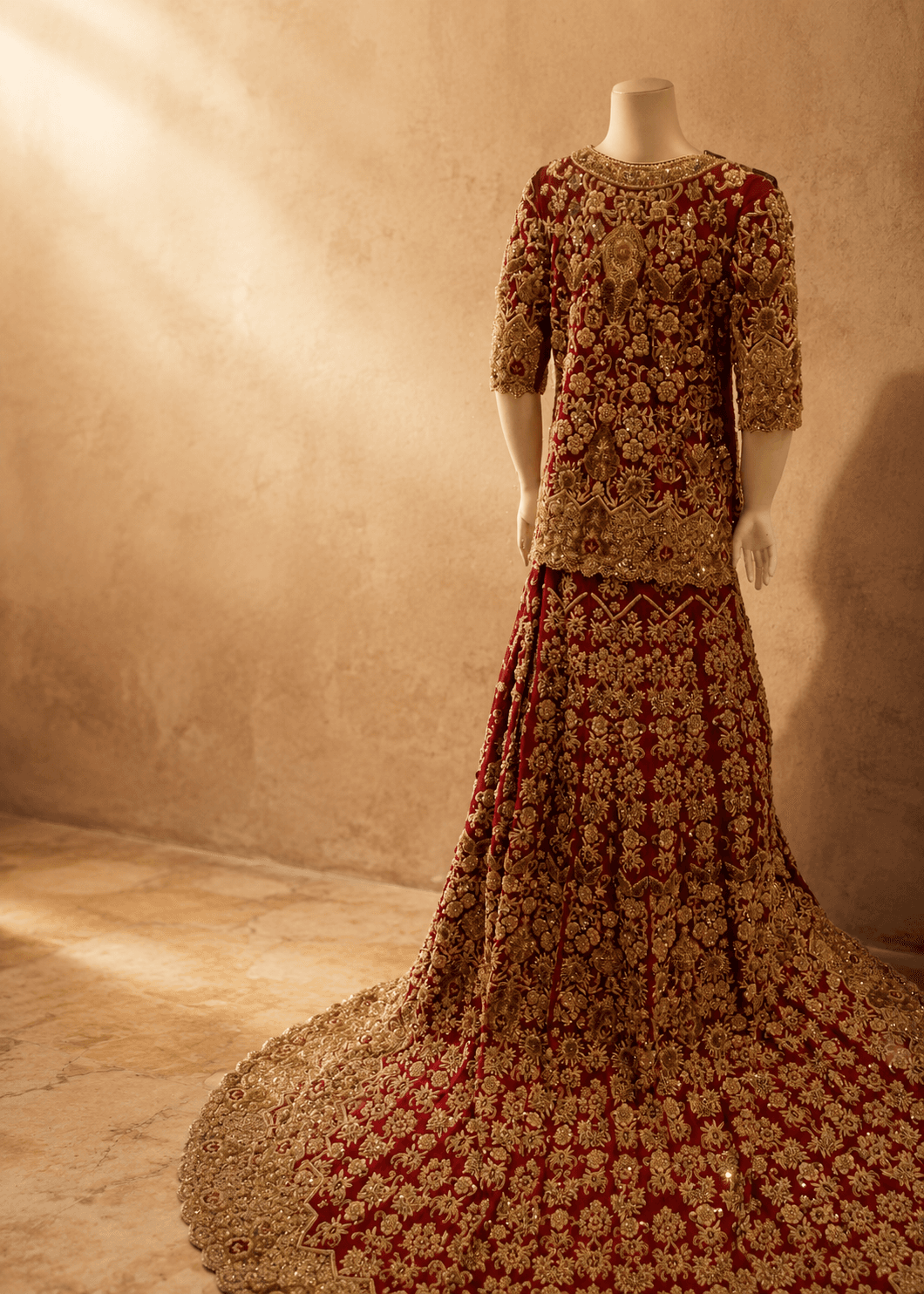
Most brides understand the lehenga. What they do not always understand is the dupatta — that the dupatta is the heaviest thing they will wear that day, often heavier than the lehenga itself, and that it is usually the last part of the trousseau to be finished.
The Banarasi tissue
The dupatta begins as a panel of Banarasi tissue, woven in Varanasi, shipped by road. Tissue is a structural compromise — light enough to drape, dense enough to hold weight. A bridal tissue is almost always pearl, ivory, or oxblood, dyed before it leaves the loom so the colour sits inside the warp, not on it.
We measure the panel before any thread touches it. Two and a half metres long, ninety centimetres wide, hemmed with a fine zari border. From this point the work is no longer mechanical.
The adda
The adda is the wooden frame the karigar stretches the cloth across. It is the oldest piece of equipment in the workshop. Ours are second-generation — the carpenter who built the first set has since retired; his son repairs the joints when they loosen.
On the adda, the panel becomes a horizontal canvas. The karigar sits cross-legged at one end, the design drawn in graphite on a butter-paper trace pinned underneath the cloth. The pattern is traditional — a vine of small floral medallions running the length of the border, a single larger motif at each corner.
Dabka, tilla, the slow stitch
Dabka is a spiral of fine gold-coloured wire. Tilla is the flat metallic thread that traces an outline. Resham is silk floss, in colours close to the ground fabric so it disappears against it. A bridal dupatta carries all three.
The karigar works in sittings of six hours, broken by tea. A skilled hand can complete one medallion in a morning. There are sixty-eight medallions on a typical bridal panel. We do not count the hours we work; we count the medallions remaining.
What you weigh at the end
When the last knot is tied, the dupatta is taken off the adda, brushed for loose thread ends, and weighed on a kitchen scale next to the front counter. The weight matters less as a measurement than as a moment — a single number that closes the work.
The last bridal panel we finished weighed two and a half kilograms. Most of that weight is the gold-coloured wire of the dabka. The tissue itself, before any work, weighed two hundred and ten grams.
The bride who collected it that afternoon held it across both her arms, the way the karigar had held it through nine months of mornings.